
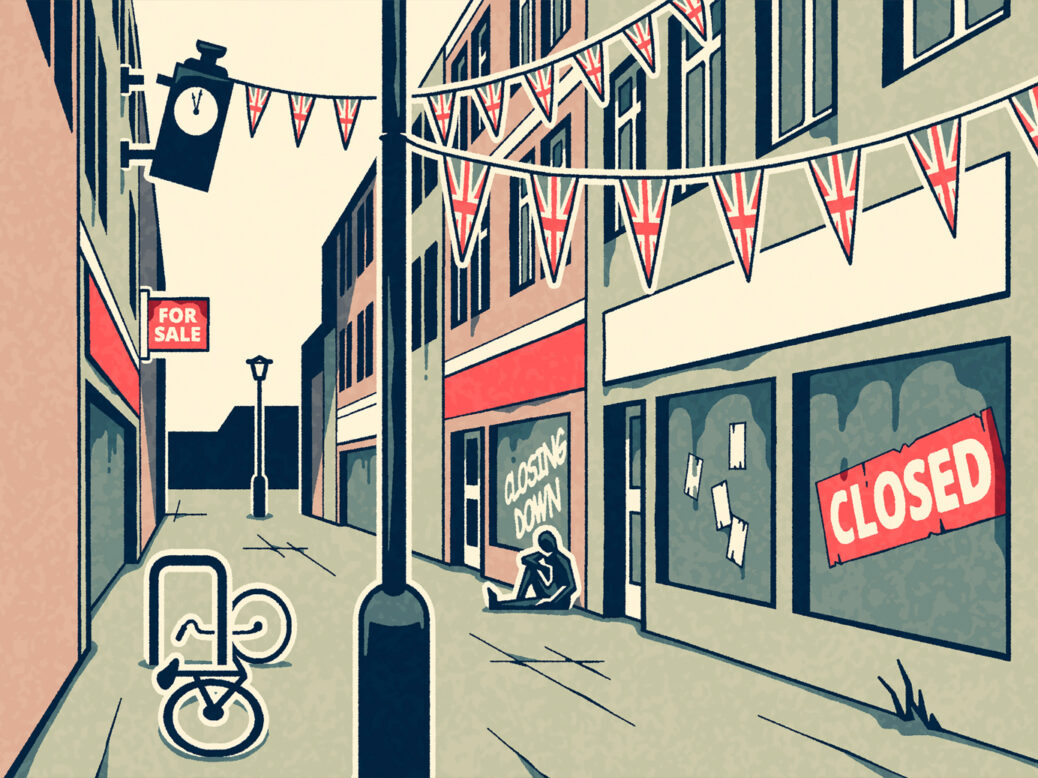
Last week, I took the train to Blackpool for a day of reporting. Leaving my flat in east London under the grey glow of early sunrise, I passed a woman with a hospital in-patient tag on her wrist, carrying a duvet as she lurched up the street. A man sitting outside the entrance of my local Underground station with puffy eyes and missing teeth mumbled and wept.
When I reached Blackpool three hours later, there was – for all the grand-day-out jollity that distinguishes the coastal town – something familiar in the sea air. Outside Cash Converters, police officers on horses watched over a smattering of midday amblers: a man in the grip of euphoria and desperation jabbered at them, stumbling up the thoroughfare, then slumped into a doorway. Further towards the seafront, a young woman, the telltale ladder of self-harm climbing up both her arms, had passed out on a bench.
This is a phenomenon that is hard to write about – for fear of dehumanising people in crisis, and because it has no name. “Disorder” or “antisocial behaviour” don’t capture the spectacle so common on British high streets of visibly chaotic lives and those in acute public distress. We have official figures counting levels of crime, homelessness and mental illness, but we don’t have a label or way to calculate such street-level chaos.
I found a few adjacent measures, though, which suggest that it is going up. The number of people sleeping rough in England is at its highest level since records began in 2010. Pharmacists (who, for example, supervise the consumption of methadone by heroin addicts) are suffering a rise in regular verbal and physical abuse. The rate of self-discharge from A&E among homeless patients has reached 17 per cent (compared with just 4 per cent of the general population who leave hospital before treatment is complete). Illicit drug dependence has almost doubled in a decade. Hospitals in England don’t have enough overnight mental-health beds.

I wrote recently about “chaos creep”: how rising rates of nuisances like shoplifting, vandalism, fare-dodging and fly-tipping have combined to create a nagging sense of public disorder. Mayhem on the streets adds to this atmosphere, seen not just in these sad individual spirals, but also in the recent organised “link-ups” of disruptive teens in Rochdale, Solihull, Birmingham and south London’s Clapham.
Highlighting this stuff is seen as fusty somehow, or even ammo for a hard right with an ideological interest in seeing cities fail. But just because everyone – not just the poorest and worthiest – now notices the inevitable result of state and council cutbacks doesn’t mean the left should avert its eyes.
Behind every person in public crisis is a story of society’s disconnection, and a false economy, too. Take Brian of Gateshead: an alcoholic, “number-one attendee” of his local A&E, and constantly in and out of trouble with police. In his own words, Brian is a man with “no connections, no network, no hope”, stuck in a cycle of being punished, patched up or sent on his way. Gateshead Council eventually discovered he had had more than 3,300 interactions with public services – police, health, council, housing, probation, etc – in the space of nine years, costing £2m. So it tried a new approach, using a small team to give him bespoke help, plus some money for clothes, food, accommodation and treatment. A year and £28k later, he was in recovery and in control of his life.
Neighbourhood police officers who know their beat well will typically come across a core handful of such vulnerable people. The unofficial protocol is to neutralise the situation, calm someone down if they’re shouting and screaming, then “move on quickly and try not to get tangled”, said Matt Lloyd-Rose, an ex-special constable in Brixton, south London, and author of the thoughtful 2023 policing memoir Into the Night.
He remembers a local woman, struggling with mental illness, dancing in traffic. All he could do was usher her off the road; fellow officers avoided her because she would spit and bite. Another time, he called an ambulance for a man who had collapsed after trying to barge into pubs and bars, “topless, very over-excited and clearly not well”. A bouncer nearby said an ambulance had also picked the man up eight hours earlier, who had ended up straight back where he started.
“We had proximity, but not a plan. That always felt very jarring to me, that we’d have interactions that would be at best pointless or fleeting, and at worst escalate the situation,” Lloyd-Rose told me. That, and there is no one obvious to call. This reflects that helpless feeling we have as passers-by – witness to someone’s slow-motion breakdown, but too wary, too busy, too unsure of what to do to help.
Police are the service of last resort. Hospitalisation is not always necessary. A conversation and warm place to sit may be all it takes to de-escalate a situation in the moment, as demonstrated in Friends and Purpose, a brilliant 2025 book by Maff Potts, who began (semi-illegally) setting up “public living rooms” in the street after growing disillusioned with his work on homelessness in government and heading a housing charity. It’s time to stop looking away from, as Potts describes them, “people on the cliff-edge of life”.
[Further reading: Kemi Badenoch wants to be Britain’s Peter Magyar]
Content from our partners


Related


This article appears in the 15 Apr 2026 issue of the New Statesman, Angry Young Women
Join the debate
Subscribe here to comment